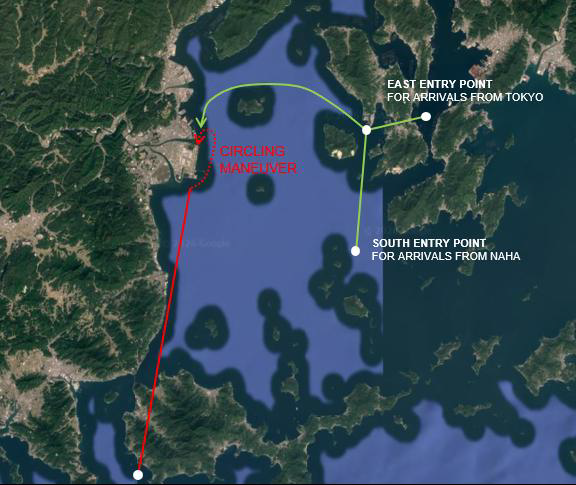
MARINE CORPS AIR STATION IWAKUNI, Japan -- Marine Corps Air Station Iwakuni has implemented a new instrument approach procedure for Runway 20, marking a major milestone in aviation safety and operational capability through a collaborative effort with All Nippon Airways (ANA), the Japan Civil Aviation Bureau (JCAB), the Federal Aviation Administration (FAA), and the Naval Flight Information Group (NAVFIG).
"For the first time in the history of MCAS Iwakuni, every aircraft operating here has a dedicated instrument approach to our southbound runway," said Col. Kenneth Rossman, commanding officer of MCAS Iwakuni. "This is a significant step forward for the installation that improves aviation safety, increases operational efficiency, and enhances our ability to safely manage both military and civilian air traffic. By reducing the need for more complex arrival procedures and opposite-direction operations, we can move aircraft more efficiently while providing a safer and more predictable operating environment. This achievement also reflects the strength of our enduring partnership with the Government of Japan and the civil aviation community."
The new procedure became operational for ANA on July 9 following more than two years of planning, coordination, testing, and regulatory approval led by MCAS Iwakuni in partnership with ANA, JCAB, the FAA, and NAVFIG.
For decades, the terrain surrounding MCAS Iwakuni made it difficult to develop a safe, straight-in instrument approach to Runway 20. As a result, aircraft often relied on more complex arrival procedures during poor weather, increasing workload for both pilots and air traffic controllers while reducing the efficiency of flight operations.
"ANA is proud to have partnered with MCAS Iwakuni on this historic project," said Mr. Ken Goto, Flight Operations Standards Department, All Nippon Airways. "This new procedure represents a significant advancement in the safety and efficiency of our operations. I would like to express my sincere thanks to everyone involved for their dedication and cooperation over the past two years. Together, we have delivered a capability that will benefit both our passengers and the broader aviation community."
Max Williams, Air Traffic Control and Airspace Manager at MCAS Iwakuni, said the project demonstrates what can be accomplished through close cooperation between military and civil aviation organizations.
"I would like to sincerely thank ANA for their outstanding partnership throughout this effort," Williams said. "Their professionalism, technical expertise, and commitment to improving aviation safety were instrumental in making this capability a reality. This project demonstrates what can be accomplished when organizations from two nations work together toward a common goal. Working alongside ANA, JCAB, the FAA, and NAVFIG, we were able to overcome a unique challenge and deliver a lasting improvement to the safety and efficiency of flight operations at MCAS Iwakuni."
The new capability is expected to improve flight operations during adverse weather, reduce delays, increase the efficiency of airfield operations, and further strengthen the longstanding partnership between MCAS Iwakuni and Japan's civil aviation community. The project represents one of the most significant enhancements to the installation's instrument flight capability in its history and demonstrates the enduring commitment of U.S. and Japanese aviation organizations to advancing safe, efficient, and reliable flight operations.